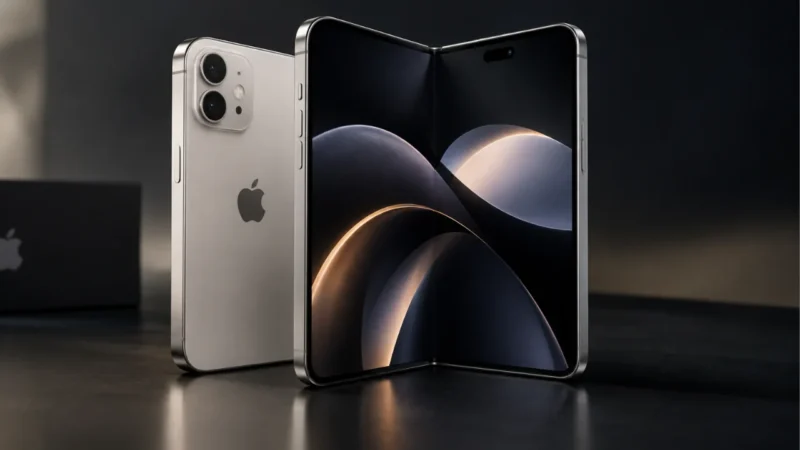
Apple has officially stepped into the foldable smartphone market, and Samsung is wasting no time responding.
The company has launched the iPhone Duo, its first foldable iPhone, bringing Apple into a category that Samsung has been developing for several years. With a starting price of $1,999, the new iPhone sits firmly in the premium segment and goes head-to-head with Samsung’s Galaxy Z Fold lineup.
But the launch is about more than another expensive smartphone. Apple’s arrival could significantly change the foldable phone market and make the category much more competitive.
Also read: Apple iPhone 18 Pro and First Foldable iPhone Launch Today: Price, Specs and Everything to Expect
Apple Finally Launches Its First Foldable iPhone
Apple stayed away from foldable phones for years while Samsung and several Chinese smartphone makers continued experimenting with different designs.
That has now changed with the iPhone Duo.
The device follows a book-style folding design, giving users a larger internal screen when the phone is opened while maintaining a more traditional smartphone form when it is closed.
Apple is positioning the device as a major addition to the iPhone family rather than simply another experimental product.
The starting price of $1,999 also makes it one of Apple’s most expensive smartphones. In India, the reported starting price is around ₹2,99,900.
For Apple, however, entering the category may be more important than the price itself. Foldable phones have become more mature over the years, giving Apple a chance to enter an already established market rather than having to create the category from scratch.
Samsung Quickly Responds to Apple
Samsung has been one of the biggest names in foldable smartphones since introducing its first major foldable devices in 2019.
After Apple’s announcement, Samsung quickly began highlighting its own experience with foldable phones.
The company used advertisements and social media posts to point out that it has been developing foldable smartphones for years. Samsung also promoted the thin design of its latest Galaxy Z Fold models.
The response makes one thing clear: Samsung sees Apple’s arrival as a serious challenge.
For years, Samsung has effectively been one of the main brands associated with foldable phones. Apple entering the same premium segment changes the competitive landscape almost overnight.
iPhone Duo vs Galaxy Z Fold 8
The timing of Apple’s launch is particularly interesting because Samsung’s latest foldable is already available.
The Galaxy Z Fold 8 starts at around $1,899, while the iPhone Duo begins at $1,999.
That relatively small price difference puts the two devices in direct competition.
Samsung has the advantage of years of experience with foldable hardware, while Apple brings the strength of its enormous iPhone ecosystem.
For buyers, the decision could ultimately come down to more than specifications.
Samsung offers an established foldable experience, while Apple is betting that existing iPhone users will be willing to pay a premium to get a foldable device without leaving the Apple ecosystem.
Apple Could Quickly Become a Major Foldable Player
The foldable smartphone market remains much smaller than the traditional smartphone market, but Apple’s entry could accelerate its growth.
Apple already has a huge global customer base. Even a relatively small percentage of existing iPhone users choosing the iPhone Duo could give Apple a significant position in the foldable segment.
Industry estimates suggest Apple could capture around 25% of the foldable smartphone market this year, while Samsung could retain a leading position with roughly 38%.
If those estimates prove accurate, Samsung would still remain ahead, but the gap would be much smaller than it might have been expected to be before Apple’s entry.
Apple’s Biggest Advantage Is Its Ecosystem
Samsung has years of experience building foldable phones, but Apple has another major advantage: its ecosystem.
For existing iPhone users, moving to the iPhone Duo could provide access to a foldable form factor while keeping familiar Apple services, apps and devices.
That could be particularly attractive to consumers who have avoided Android foldables because they already use products such as Macs, iPads, Apple Watches or AirPods.
Apple therefore does not necessarily need to convince consumers that foldable phones are useful.
It needs to convince them that its version of a foldable iPhone is worth the premium price.
Samsung Has Years of Foldable Experience
While Apple’s ecosystem is a major strength, Samsung still has an important advantage that cannot be created overnight.
The company has been developing foldable smartphones for years.
With multiple generations of Galaxy Z Fold devices, Samsung has had time to improve hinge technology, displays, durability, thickness and overall usability.
That experience could matter as consumers begin comparing Apple’s first foldable directly with Samsung’s latest models.
Samsung also has a broader foldable portfolio, giving it experience with different designs and price segments.
Apple Is Also Using an Established Foldable Supply Chain
Another interesting part of Apple’s entry into the category is the supply chain behind the device.
Apple is reportedly working with suppliers that already have experience producing components for foldable smartphones, including foldable display technology associated with Samsung Display.
This highlights how much the foldable industry has developed before Apple’s arrival.
Samsung helped establish the category and build demand for foldable displays, while Apple is now entering that same ecosystem with its own product.
Could Apple Make Foldables Mainstream?
Foldable phones have been available for several years, but they remain a relatively small part of the smartphone market.
Apple’s involvement could change that.
The iPhone has a massive global audience, and Apple’s marketing reach could introduce foldable smartphones to consumers who have never seriously considered buying one.
If the iPhone Duo becomes successful, competitors may have even more reason to improve their own foldable designs.
That could lead to better displays, thinner phones, stronger hinges and eventually more affordable foldable devices.
For consumers, increased competition could be the biggest benefit.
The Premium Smartphone Market Is Getting More Expensive
The iPhone Duo also arrives at a time when premium smartphone prices are already moving higher.
Apple’s latest Pro models have become more expensive, while other manufacturers are also dealing with higher component costs.
The growing demand for chips and memory from AI infrastructure is one factor contributing to pressure across the technology supply chain.
That makes the iPhone Duo’s $1,999 starting price particularly significant.
Apple is clearly positioning its first foldable as a premium product rather than trying to compete with lower-cost foldable phones.
What Apple’s Entry Means for Android Foldables
Apple’s arrival does not mean Samsung or other Android manufacturers are suddenly in trouble.
In fact, competition could benefit the entire category.
Samsung may have even more reason to improve future Galaxy Z Fold models. Chinese smartphone manufacturers could continue competing through aggressive pricing and hardware innovation, while Google and other Android brands may invest further in foldable software.
Apple’s entry could also push developers to pay more attention to applications that take advantage of larger foldable screens.
As the number of foldable users grows, software experiences could become just as important as the hardware itself.
Also read: WhatsApp Could Soon Warn Users About Unofficial Web Clients: What It Means for Your Privacy
Final Thoughts
The iPhone Duo represents a major moment for the smartphone industry.
Apple is entering a market that Samsung helped build, but it is doing so with the enormous reach of the iPhone ecosystem behind it.
Samsung has the experience and an established foldable lineup. Apple has a huge customer base and a tightly connected ecosystem.
With both companies now competing at the premium end of the foldable market, consumers have more choice than ever.
The real impact of Apple’s first foldable may become clearer over the coming months. But one thing is already obvious: the foldable smartphone race has become much more interesting now that Apple is part of it.