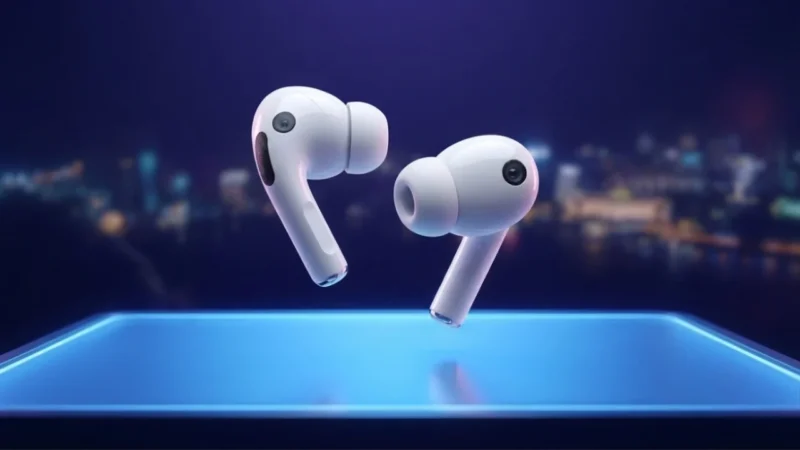
At first glance, the idea of AirPods with built-in cameras sounds strange. After all, wireless earbuds are meant for listening to music, taking calls, and interacting with voice assistants—not capturing images. However, several industry reports and Apple analysts suggest that the company has been exploring the possibility of integrating tiny cameras into future AirPods.
While Apple hasn’t officially confirmed such a product, the concept aligns with the company’s long-term vision of blending artificial intelligence, spatial computing, and wearable technology into everyday life.
So why would Apple put cameras inside AirPods? Let’s take a closer look at the potential reasons, possible features, challenges, and what this could mean for the future of wearable devices.
Also read: Meta’s New AI Image Tool Could Enable Deepfakes — Here’s How to Protect Yourself on Instagram
The Rumours Around Camera-Equipped AirPods
Reports over the past year have suggested that Apple is researching ways to integrate miniature cameras into future versions of AirPods. These wouldn’t function like traditional smartphone cameras designed for photography or video recording.
Instead, experts believe these sensors would primarily collect environmental information, helping Apple’s AI systems better understand the user’s surroundings.
If these rumours prove accurate, camera-equipped AirPods could become an important part of Apple’s broader artificial intelligence ecosystem.
Why Would Apple Add Cameras to AirPods?
The answer lies in contextual awareness.
Apple has been investing heavily in technologies that allow devices to understand what’s happening around the user instead of simply responding to commands.
Tiny cameras could help AirPods “see” the environment and provide smarter assistance in real time.
Rather than replacing your iPhone camera, these sensors would likely act as visual inputs for AI-powered features.
A Smarter Siri Experience
One of the biggest beneficiaries of camera-equipped AirPods would be Siri.
Today’s voice assistants mainly rely on spoken commands. With visual input, Siri could understand situations instead of relying only on your words.
For example, you could ask:
- “What building am I looking at?”
- “Which train platform is this?”
- “Read this sign for me.”
- “Where did I leave my keys?”
Instead of asking you to take a picture, Siri could analyze your surroundings instantly using information captured by the AirPods.
This could make conversations with Apple’s AI assistant far more natural.
Better Integration With Apple Intelligence
Apple has already introduced Apple Intelligence, its new AI platform designed to provide smarter and more personalized assistance across Apple devices.
Camera-equipped AirPods could become another source of real-world information for Apple Intelligence.
Possible AI features could include:
- Object recognition
- Scene understanding
- Real-time suggestions
- Smart reminders based on location
- Context-aware notifications
This would allow Apple Intelligence to become more proactive instead of simply reacting to user commands.
Enhancing Spatial Computing
Apple has made it clear that spatial computing is one of its biggest priorities, especially after the launch of Apple Vision Pro.
AirPods with cameras could help improve spatial awareness by detecting objects, distances, and movement around the user.
This information could enhance:
- Augmented Reality experiences
- Navigation
- Hand tracking
- Environmental mapping
- Gesture recognition
Together with Vision Pro or future AR glasses, AirPods could become another important sensor in Apple’s ecosystem.
Improved Accessibility Features
Perhaps one of the most meaningful applications would be accessibility.
Apple has consistently introduced features that help users with visual or hearing impairments.
Camera-equipped AirPods could potentially assist by:
- Reading signs aloud
- Identifying nearby objects
- Recognizing people
- Describing surroundings
- Detecting obstacles
Combined with Siri, these capabilities could make everyday navigation much easier for many users.
Real-Time Language Translation
Apple has gradually improved translation features across iOS.
With visual sensors, AirPods could take language translation even further.
Imagine walking through another country and hearing:
- Street signs translated instantly
- Restaurant menus explained
- Public announcements interpreted
- Foreign text read aloud
Instead of relying only on microphones, cameras could provide additional context for more accurate translations.
Better Gesture Recognition
Future AirPods may also recognize simple head movements and gestures more accurately.
Visual sensors could help detect:
- Head orientation
- Hand gestures
- Eye direction (when paired with other Apple devices)
- Body movement
This could enable hands-free controls without touching the earbuds.
Supporting Apple Glasses
Many analysts believe Apple is developing lightweight smart glasses.
If that happens, AirPods with cameras could complement those glasses by providing additional environmental data.
Rather than placing every sensor inside the glasses, Apple could distribute different technologies across multiple devices:
- AirPods
- Apple Watch
- iPhone
- Apple Glasses
This approach would reduce weight while improving overall performance.
Privacy Will Be Apple’s Biggest Challenge
Whenever cameras become part of wearable devices, privacy concerns naturally follow.
Many users may worry about:
- Being recorded without permission
- Hidden image capture
- Data collection
- Facial recognition
Apple has traditionally emphasized privacy as a major selling point, so any future product would likely include strict protections.
Possible safeguards could include:
- No photo or video recording capability
- On-device image processing
- Clear hardware indicators
- No cloud storage by default
- Limited visual data collection
Apple would almost certainly prioritize privacy to maintain user trust.
Technical Challenges
Adding cameras inside tiny wireless earbuds is far from easy.
Engineers would need to solve several problems, including:
Battery Life
Additional sensors require more power, which could reduce playback time.
Heat Management
Processing visual information generates heat that must be managed safely inside compact earbuds.
Size Constraints
AirPods are already packed with speakers, microphones, batteries, wireless chips, and sensors.
Finding room for cameras without making them larger would be a major engineering challenge.
Processing Power
Visual AI tasks require significant computing resources.
Apple may rely on nearby devices like the iPhone or dedicated AI chips to handle heavy processing.
When Could They Launch?
At the moment, there is no official confirmation that Apple plans to release AirPods with cameras.
Industry analysts suggest the technology is still under research and development.
If Apple decides to move forward, such AirPods would likely arrive alongside broader AI or spatial computing initiatives rather than as a standalone feature upgrade.
Could They Replace Your Phone Camera?
Almost certainly not.
The rumored cameras would likely be very small and optimized for AI sensing instead of photography.
Their purpose would be environmental awareness rather than taking selfies or recording videos.
Your iPhone would remain Apple’s primary photography device.
Also read: ChatGPT Voice Gets GPT Live Upgrade With Real-Time Conversations
Final Thoughts
AirPods with built-in cameras may sound unusual today, but the concept fits perfectly into Apple’s long-term strategy of creating smarter, AI-powered wearable devices. Instead of focusing on photography, these tiny cameras could help Siri understand your surroundings, improve Apple Intelligence, enhance accessibility, enable better spatial computing, and deliver more personalized assistance throughout the day.
While the technology is still based on industry reports and hasn’t been officially announced, it highlights where wearable technology could be heading. If Apple successfully balances innovation with user privacy, camera-equipped AirPods could eventually become much more than wireless earbuds—they could evolve into intelligent companions that see, understand, and assist in ways today’s devices simply cannot.